
Guide
When the days get shorter: vision changes in a parent
How to spot vision loss in an elderly parent, brighten the home for aging eyes, and find low vision help in Cleveland, Ohio.
Vision loss in an elderly parent usually shows up first in small, everyday slips: a spill on the counter, a missed step, mail that sits unread. Most of it can be helped. A good eye exam, more light in the right places, and a few local services can make home safer and keep your parent doing the things they love.
November is when many families notice. By five o'clock it is dark in Cleveland, the lamps go on, and the house your mom or dad has lived in for forty years suddenly has corners they cannot quite see. You might catch them squinting at the stove dial, or holding the TV remote an inch from their nose, and wonder how long it has been like this.

The quiet signs a parent's eyesight is changing
Picture the kitchen counter after your dad makes coffee. A ring of spilled grounds, a drip down the cabinet, and a sugar bowl pushed to the very edge. None of it is a crisis. Together, it is a pattern worth noticing.
Eyesight tends to change slowly, so the person living with it adapts without noticing. Here is where to look.
Around the kitchen and the table
- Food stains on clothes, or a shirt buttoned one hole off
- Spills when pouring, and reaching for a cup and missing it
- Burned food, or dials and timers set wrong
- Expired food in the fridge, because the dates are too small to read
- Pills that look alike being mixed up
Around the house and out the door
- The TV turned louder or moved closer, and books and crossword puzzles set aside
- Mail and bills piling up, or checks written on the wrong line
- Bumps on the shins, a hand on the wall in hallways, a slower step on the stairs
- Not recognizing a neighbor until they speak
- Turning down evening plans, or no longer wanting to drive after dark
One sign alone may mean nothing. Three or four, especially if they are new since last winter, are a good reason to book an eye exam.
Eyesight tends to change so slowly that the family often notices before the parent does.

Why poor eyesight can look like confusion or a low mood
Think of a parent who used to read the paper cover to cover and now leaves it folded by the chair. From the outside it can look like they have lost interest in the world. Very often, they simply cannot see the print.
Vision loss can look like many other things. A parent who cannot read a menu may order the same meal every time. One who cannot see faces in a crowded room may go quiet at family dinners. One who cannot read labels may take the wrong pill. These can look like memory problems, and sometimes families worry about the wrong thing first.
When a parent sees things that are not there
Some people with significant vision loss, often from macular degeneration or glaucoma, begin to see vivid pictures that are not real: patterns, flowers, faces, even small animals. This has a name, Charles Bonnet syndrome. It is not a mental illness, and most people know the images are not real. Many are afraid to mention it because they worry what it means. If your parent describes something like this, tell the eye doctor and their primary doctor. Knowing what it is often brings real relief.
The mood side of it
Losing the ability to read, sew, play cards, or drive to see friends can wear on anyone. It is natural for a parent to feel down or pull back. The good news is that most of these activities can come back with the right tools, more light, and a bit of help. If the low mood lasts, mention it to their doctor. And if memory itself seems to be changing, our page on memory changes walks through what to watch for.
A brighter, safer home for aging eyes
Walk through your parent's home just after dusk and stand where they stand. The hallway light that seemed fine at noon throws a long shadow across the stairs. The bathroom has one bulb over the mirror and a shiny floor that glares back at you. This is the version of the house your parent lives in from late afternoon on.
Older eyes need a lot more light. Lighting researchers suggest living spaces for older adults have two to three times the light a younger person finds comfortable, and even more for close tasks like reading or cooking. They also need less glare and more contrast. Three simple ideas do most of the work: more light, softer light, and strong contrast.
More light, softer light
- Add lamps rather than relying on one ceiling fixture. Put a reading lamp beside the chair your parent actually uses.
- Choose bright, warm LED bulbs and use shades that hide the bulb. Bare bulbs and clear glass fixtures create glare.
- Light the path at night with plug-in night lights from the bed to the bathroom.
- Put lights at the top and the bottom of the stairs, with switches at both ends.
- Use sheer curtains or blinds to soften harsh low sun in the afternoon. In winter, snow outside can bounce strong glare through the windows.
Contrast and order
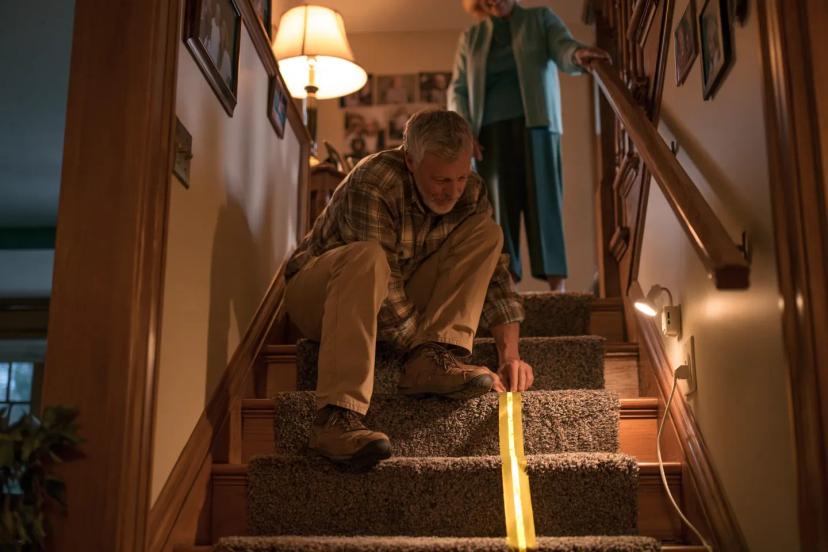
- Mark the edge of each step with bright tape or paint in a color that stands out against the stair.
- Use a dark cutting board for light foods and a light one for dark foods. Choose plates that stand out from the tablecloth.
- Put a contrasting rug or towel in the bathroom so the tub and toilet are easier to see, and make sure every rug is secured or removed.
- Keep things in the same place every time. Put the keys, glasses and phone on one tray by the door.
- Use large print or bump dots on the stove, microwave and thermostat. A rubber band or a strip of tape on each pill bottle helps tell them apart by touch.
For the refrigerator door
- A lamp beside the favorite chair, with a shade that hides the bulb
- Night lights from the bedroom to the bathroom
- Lights and switches at the top and bottom of the stairs
- Bright tape on the edge of every step
- Rugs secured or removed, cords out of walkways
- Keys, glasses and phone on one tray by the door
- Large print or raised dots on the stove and microwave
- An up to date list of medications in large print
- The date of the last full eye exam, and the next one booked
Help around the house can make these changes stick. Our caregivers can keep paths clear, read the mail aloud, offer reminders when it is time for medications, and cook in good light. You can read about meals and housekeeping help on our site.
How to bring it up and get an eye exam
Imagine sitting with your mom over coffee and saying, "Your eyes are going." It lands like a verdict. Now imagine saying, "The kitchen is so dark this time of year. Can I put in a brighter lamp?" That is a door, not a judgment.
The words that open a door
Start with the room, not the person. Talk about the light, the stairs, the small print on everything these days. Then make the exam about something they care about: reading to the grandchildren, getting back to the crossword, staying comfortable on the stairs. Offer to drive and come in with them.
What to bring to the appointment
Bring their current glasses, a list of medications, and a short note of what you have both noticed: the spills, the stairs, the trouble with faces. Ask the eye doctor directly whether your parent would benefit from a low vision evaluation. That is a separate kind of exam that looks at how your parent can use the vision they have, with magnifiers, lighting and training. If cataract surgery comes up, your parent will need a ride home that day, and our transportation help can be part of that plan.
What Medicare pays for
Original Medicare does not cover routine eye exams for glasses, or glasses themselves, with one exception after cataract surgery. Part B does cover several things that matter for older eyes, according to Medicare's own coverage pages:
- A yearly eye exam for diabetic retinopathy, for people with diabetes
- A yearly glaucoma test for people at high risk, which includes people with diabetes, a family history of glaucoma, African Americans age 50 and older, and Hispanic Americans age 65 and older
- Certain tests and treatment for macular degeneration
- Cataract surgery, and one pair of standard eyeglasses or one set of contact lenses after surgery with an implanted lens
The usual Part B deductible and 20 percent coinsurance apply. Many Medicare Advantage plans add routine eye exams and an allowance for glasses, so check your parent's plan card or call the number on the back.
Low vision help in Greater Cleveland
When glasses, surgery and medicine cannot bring vision fully back, that is called low vision. It does not mean nothing can be done.
Cleveland Sight Center
The Cleveland Sight Center in University Circle offers low vision exams with optometrists and occupational therapists, who recommend magnifiers, lighting, glare control and training that fit your parent's daily life. It also runs vision rehabilitation, including help with cooking, getting around safely and using phones and computers, and an independent living program for people 55 and older.
Help from the State of Ohio
Opportunities for Ohioans with Disabilities runs the Independent Living Older Blind program for Ohioans 55 and older whose vision loss is getting in the way of daily life. It can include training to get around safely, daily living skills, low vision aids and magnifiers, and counseling. You can learn more at ood.ohio.gov.
Books and the newspaper, by ear
The Ohio Library for the Blind and Print Disabled lends talking books, magazines and a free player by mail, at no cost, for people who cannot read standard print. A doctor, optometrist, nurse, social worker or librarian can sign the application. Your parent's local branch of Cleveland Public Library, Cuyahoga County Public Library, or the Lake and Lorain library systems can help you find the form.
Help at home
Some families need an extra set of eyes at home, a few hours a week. A caregiver can read the mail aloud, keep the house well lit and clear, cook, and drive to appointments and the grocery store. That kind of steady help often lets a parent with low vision stay in the home they know best, across Cuyahoga, Lake and Lorain counties.
Low vision does not mean nothing can be done. It means it is time for different tools.
Questions families ask
My dad says his eyes are fine. Should I push for an exam?
Start smaller. Offer to fix the lighting first, then mention that his last exam was a while ago and you would like to drive him. Many parents agree once it is framed as routine. If he keeps refusing and you see safety signs, such as falls, medication mix ups or burns, share what you have seen with his primary doctor, who can recommend the exam.
Is it normal for vision to get worse every winter?
The eyes themselves do not change with the season, but the light does. Shorter days, low sun, glare off snow and dim indoor lighting all make existing vision problems easier to notice. If your parent struggles much more in the winter, that is often a sign an exam is due and that the home needs more light.
Can my mom still live alone with macular degeneration?
Many people with macular degeneration live on their own for years. A low vision evaluation, good lighting, contrast, and simple systems for pills and mail make a big difference. Some families add a caregiver for a few hours a week for errands, cooking and reading mail.
Who can drive my parent to an eye appointment or cataract surgery?
Driving is hard for a few hours after dilating drops, and after cataract surgery your parent will need a ride home. Family members often take turns. Some health plans offer rides, and local senior centers sometimes do too. A home care caregiver can also drive to the appointment, wait, and help your parent settle back in at home afterward.
A note from Solura
The early dark of November has a way of showing us things we missed in summer. If you have noticed your mom or dad squinting at the stove, reaching for the wall in the hallway, or setting aside the books they love, you are paying attention in exactly the right way. Most of what you are seeing can be helped, and much of it starts with a lamp, a roll of bright tape and one eye exam.
If you would like help thinking through what comes next, we are glad to listen. You can start a care plan online, or talk with us about what a few hours of help at home could look like.
If you ever have a question, just reply to the email this came with or call (216) 770-4886. No rush at all.
The Solura Home Care Team