
Guide
The folder in the kitchen drawer
Ohio's health care power of attorney, living will and financial power of attorney, and how to raise the subject gently with a parent.

There is a folder, or there should be, in a kitchen drawer somewhere. Not a thick one. A few pages that say who speaks for your mom if she cannot speak for herself, and what she would want them to say. Most families do not have it. Not because they do not care, but because the right afternoon to sit down and make it never quite seems to arrive.
This letter is about that folder. What goes in it, how to fill it out here in Ohio, and how to raise the subject with a parent who would rather talk about almost anything else. None of it takes a lawyer, and none of it needs to happen today. It only needs to happen while the choosing is still theirs.
The quiet afternoon is the right time
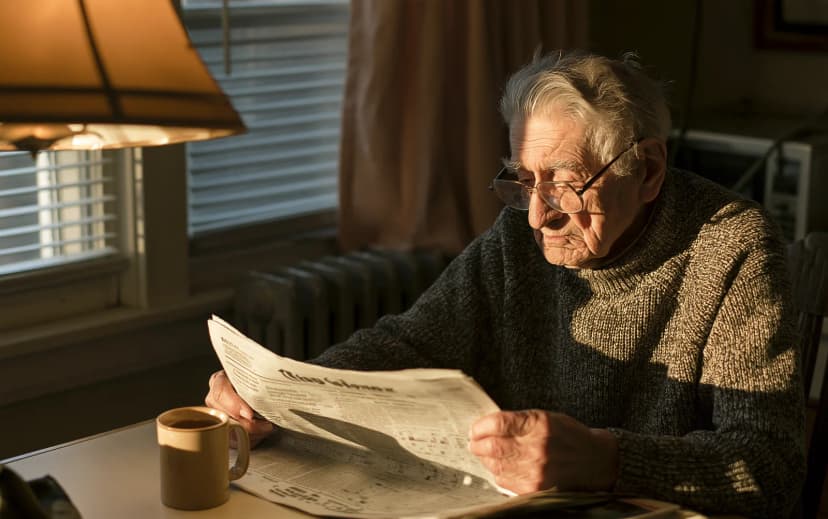
Picture an ordinary Tuesday. The heat is running against the first real cold off the lake, the kind that arrives in Cleveland sometime in November and does not leave. Your dad is halfway through the crossword. Nothing is wrong. This is the afternoon nobody ever thinks to use, and it is the exact one that matters most.
Because there is another kind of afternoon, and most families meet it without warning. A fall, a stroke, a sudden turn, and then a hallway at the Clinic or University Hospitals where a kind nurse asks who makes the decisions now. If no one ever wrote it down, the answer is not simple. In Ohio, when there is no health care power of attorney, the law turns to a set list of relatives to decide, and your family is left guessing at wishes your parent never quite said out loud.
Many adults have never put any of this on paper. That is not carelessness. It is just that the task has no deadline, so it waits, and waits, until a day arrives that it should never have waited for.
The papers do not take anything away from your parent. They do the opposite. They keep your parent's own voice in the room on the day they cannot raise it. And the only cost of having them is one quiet afternoon, spent while nothing at all is wrong.
The papers are not about dying. They are about making sure your mom's own voice is the one in the room.
Two papers for the doctor
A nurse leans in, gentle but direct. "Does your mom have a health care power of attorney? Who is her decision maker?" And there it is, the pause, the one where you realize you are about to make enormous choices on the strength of a guess. Two short documents keep you out of that pause. They do different jobs, and your parent wants both.
Who speaks for them
The Health Care Power of Attorney names one trusted person to make medical decisions when your parent cannot. In Ohio that person must be an adult, and cannot be your parent's own doctor or a nursing home administrator, unless they happen to be family or share the same religious community. Your parent can name up to two backups, in case the first person is unreachable. This is the document that answers the nurse's question before she ever has to ask it.
What they would want
The Living Will puts in writing which life-sustaining treatments your parent would or would not want, but only in two narrow situations: if they were ever terminally ill, or permanently unconscious, with no reasonable hope of recovery. One thing worth saying plainly, because it worries families most: choosing to decline life-sustaining treatment never means declining comfort. Pain relief, warmth, and gentle care continue, always.
How the two work together
The two work as a pair. The living will speaks for the situations your parent could foresee. The health care power of attorney gives a real person the standing to decide the hundred situations no form could predict. If the two ever seem to point different ways, ask the attorney how Ohio law settles it.
Neither one needs a lawyer. Both become official the same simple way: your parent signs in front of one notary, or in front of two qualified adult witnesses. In Ohio a witness cannot be the named agent, a close relative, your parent's doctor, or a nursing home administrator. That is the whole ceremony.
The paper for the bank
The mail piles up on the counter the way it always has. The electric bill, a Medicare statement, the checkbook your mom still balances by hand at the kitchen table. For now she manages it all beautifully. But picture the week she cannot, and picture a devoted daughter trying to pay that electric bill, only to be told, politely, that her name is on nothing and she has no authority to do a thing.
That is the gap a Durable Financial Power of Attorney closes. It names someone your parent trusts to handle money and property on their behalf. The word durable is the entire point. It means the document stays in force even if your parent later becomes unable to manage things themselves, which is precisely the moment it is needed.
What it can cover
Paying the bills and managing the bank accounts. Handling Social Security and Medicare paperwork. Dealing with the house, the car, and insurance. Signing tax returns. In short, keeping an ordinary financial life running smoothly on a day your parent would rather not have to think about any of it.
Why you do it early
This document can only be signed while your parent still understands what it means. Miss that window and the family is left with the slow, public, expensive road of asking a court to appoint a guardian. A joint bank account is not a substitute, either. It does not reach the house, the car, the insurance, or the taxes.
Worth an attorney's half hour
This is the one piece of the folder worth an attorney's half hour. The health care forms you can do yourselves, but a financial power of attorney is best drafted to fit your parent's actual situation. An elder law attorney in Cuyahoga County can put one together without much fuss, and it is money well spent.
The window that matters

A parent at the kitchen table, reading a form in the good afternoon light by the window, pen resting in their own hand. Hold onto that picture, because that small moment, the pen in their own hand, is the whole reason to do this early rather than someday.
There is one rule underneath every document in this letter. To sign any of them, your parent has to be able to understand what the paper means and what it does. As long as they can, the choosing is entirely theirs. That is the point and the gift of it.
An early diagnosis, the first soft signs of memory loss, does not slam that door shut. People in the early stages very often understand these choices perfectly well. But it does start a quiet clock. The sooner the papers are signed, the more of your parent's own voice gets written into them, and the less anyone is ever left to guess.
None of this is about fear, and none of it is about rushing a frail person through a stack of legal forms. It is about something kinder. It is about making sure the decisions are made by the person they are actually about, in their own words, while that is still fully possible. If you are ever unsure whether a parent can still take this on, their own doctor can help you understand where they stand.
The kindest time to sign is a quiet one, long before anyone needs the papers at all.
How to bring it up

The table is cleared, the game is on low in the other room, and for once everyone is under one roof and nobody is in a hurry. This is the quiet gift the holidays hand you. These conversations need exactly one thing, time together and no clock, and late November tends to be the only week of the year that reliably offers it.
So use it, lightly. Lead with your parent, not with the paperwork. Ask one-on-one, in the kitchen or on a walk, not across a circle of relatives that can feel like an ambush. And start with a question, not a folder: a single honest "if you were ever really sick, who would you want making the calls?" opens more doors than any form ever will.
Words that open a door
"Help me understand what matters to you." "I want to get this right for you, not have to guess." "Can you walk me through how you would want this handled, so I never have to wonder?" Then the hardest part, which is to stop talking and listen. You are not there to decide anything. You are there to find out what they want, so that one day it can simply be followed.
What not to lead with
The word "lawyer" on the very first pass. A thick folder of forms set down before a single question is asked. "We need to talk about what happens when you are gone," which makes everyone flinch. And the whole list in one marathon sitting. These close doors that a slower, softer approach would have left open.
One conversation is plenty
One good conversation is plenty for one visit. You do not need signatures by the end of the weekend. The papers will keep. What you are after this time is simply the door, left open, and your parent feeling heard rather than managed.
You are not asking them to give anything up. You are asking them to be heard.
Where the papers live
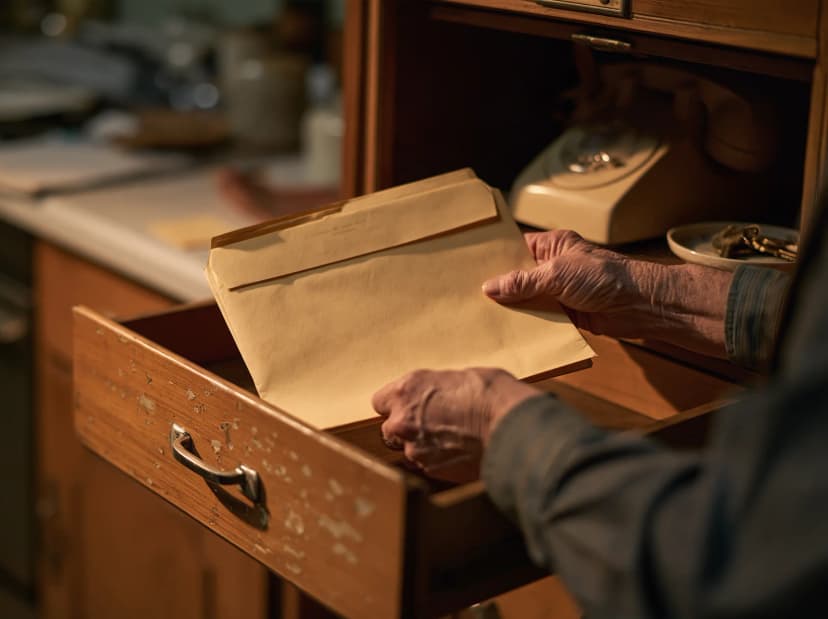
A plain manila folder, labeled in your mom's own handwriting, in the drawer by the phone. Not locked in a safe deposit box the family cannot open on a Sunday night. Somewhere a person can actually reach in the moment it is needed. A document nobody can find is, for all practical purposes, a document that was never signed.
So once the papers are done, the last small job is making sure the right hands hold them. Give a copy to your parent's doctor, a copy to the person named as agent, and a copy to any backups. Keep the originals somewhere safe and easy to reach, and make sure one trusted person knows exactly where that is. A small card tucked in the wallet, noting that the documents exist and naming the agent, quietly travels with your parent to every appointment and every emergency room.
And treat it as a living thing, not a task you finish once. Look the papers over again after any real change: a new diagnosis, a move, a loss in the family, a falling out, a new marriage. Wishes shift, and the folder should keep up with them.
Here in Ohio the two health care forms are free, and official. LeadingAge Ohio publishes the state's living will and health care power of attorney in its "Choices" booklet, available at ohioadvancedirectives.com, and Ohio Legal Help offers free fillable versions you can complete online. If you would rather not do it alone, the Western Reserve Area Agency on Aging and the social workers at any Cleveland-area hospital are kind, free, and glad to point you the right way.
The four papers worth having
For the refrigerator door:
- A Health Care Power of Attorney, naming who speaks for your parent
- A Living Will, stating their wishes about life-sustaining treatment
- A Durable Financial Power of Attorney, for money and property
- A simple, up to date will (an elder law attorney can help here)
- Each one signed the Ohio way: one notary, or two qualified adult witnesses
- A copy given to the doctor, to the named agent, and to any backups
- The originals somewhere safe and easy to reach, with one person who knows where
You do not need a lawyer for the two health care forms. Here in Ohio, they are free.
A month, not an afternoon
This week
Download Ohio's free living will and health care power of attorney, and read them over coffee. Nothing to sign yet.
The next visit
One quiet conversation. Ask what matters to your parent, and mostly listen.
When it feels right
Sign with a notary or two witnesses, then hand out the copies. Done, and off everyone's mind.
The small things, handled
A folder in a drawer is a quiet kind of love. It is one of the few things you can do for a parent that asks for nothing in return, and spares them, and you, a great deal on some future hard day. If it has been sitting near the bottom of your list for a while, let this letter be the gentle nudge to take just the first small step.
When the papers are signed, the rest is daily life, and that is where we come in. We can sit with your family, help you track down the right Ohio forms, work alongside your parent's doctor, and make sure the care at home matches the wishes on the page. Wherever you are in all of this, whether you have a full folder or a blank one, we are glad to help you take it one step at a time.
If a parent needs help at home while the family sorts this out, see how care at home works and what care costs and how families pay.
If you ever have a question, just reply to the email this came with or call (216) 770-4886. No rush at all.
The Solura Home Care Team